
Chapter 12. Memory Management
- in the textbook “C Primer Plus”, p.511–564
Void pointer
int * p; // int: destination type / target type

void *q; /* a void pointer can point to any type of object */
int n = 123;  double x = 1.23;
q = &n; /* OK */
q = &x; /* OK */
*q = 3.14; /* invalid; cannot dereference a void * */
* (double *) q = 3.14; /* OK */
- A void pointer can point to any type of object
- A void pointer connot be directly dereferenced
int n = 123;
void *p = *n;
int *q = p;
*q = 456 /* changes n to 456 */
- A void pointer is compatible with any other type of pointer to object
e.g.
p = q; (void * = int *)q = p; (int * = void *)
Lifetime of objects
- Right now, we have 2 kinds of objects - local vs. global (a.k.a external)
example)
int n; /* external object; lifetime is duration of program */
int main(void) {
	int x = 1; /* local to main */
	.....
	if(x == 1) {
		int y = 2; /* local to if */
		.....
		.....
	} /* y destroyed here */
	.....
	return 0;
} /* * destroyed here */
- Lifetime of a local object is the duration of execution of the block in which it is created.
- Lifetime of an external(global) object is the duration of the program.
- Uninitialized local variables have random(garbage) values
- However, uninitialized external variables contain 0’s.
Dynamic Memory
- Gives us more control over the lifetime of an object (we can create an object at any time and destroy it at any later time)
#include <stdlib.h>
malloc // for allocating dynamic memory
calloc //        (same as above)
realloc // typically used to resize dynamic memory
free // for deallocating dynamic memory
malloc()
Example: allocating dynamic memory for IO ints
int *p;
p = malloc(10 * sizeof(int));
if(p == 0) { /* when malloc() returns null pointer (0) */
  fprintf(stderr, "unable to allocate memory \n");
	exit(1); /* error code: 1 */
}
/* use the array of 10 ints */
p[0] = p[2] = p[4] = p[6] = p[8] = 0; /* dynamic array */
p[1] = p[3] = p[5] = p[7] = p[9] = 1;
/* deallocate memory when done */
free(p);
- What if we need to allocate a dynamic array of 10 doubles?
double *p = malloc(10 * sizeof(double));
- What is the return type of malloc()?
// prototype //
void * malloc(size_t){}
/* this is why we had to talk about void pointer!! */
/* malloc returns object pointer that can be used for any object type */
malloc()returns the starting addrress of the block memory it allocates or the null pointer of failurememory allocated by malloc contains random values - different than calloc
calloc() - almost the same as malloc() except
it zeros out the allocated memory (i.e. allocated memory contains 0’s)
calloc takes 2 arguments — the no. of objects and the size of each objecct
int *p = calloc(10, size(int));
// prototype //
void * calloc(size_t, size_t){}
realloc() - change size of the allocated memory
// prototype //
void * realloc(void *p, size_t, newsize);
/* p = pointer to original block */
- 2 special cases:
realloc(p, 0) ≣ free(p)
realloc(0, size) ≣ malloc(size)
Example
int *p, *tmp;
if((p = malloc(10 * sizeof(int))) == 0) {
	fprintf(stderr, "...");
  exit(1);
}
/* use the 10 ints */
/* Assume 10 ints is not enough; resize to 20 ints */
if((tmp = realloc(p, 20 * sizeof(int))) == 0) {
  fprintf(stderr, "unable to resize memory \n");
} else {
  p = tmp; /* p now points to a block of 20 ints with the original 10 ints */
}
/* free memory when done */
free(p);
- Assuming realloc succeeds, there are still 2 possibilities:
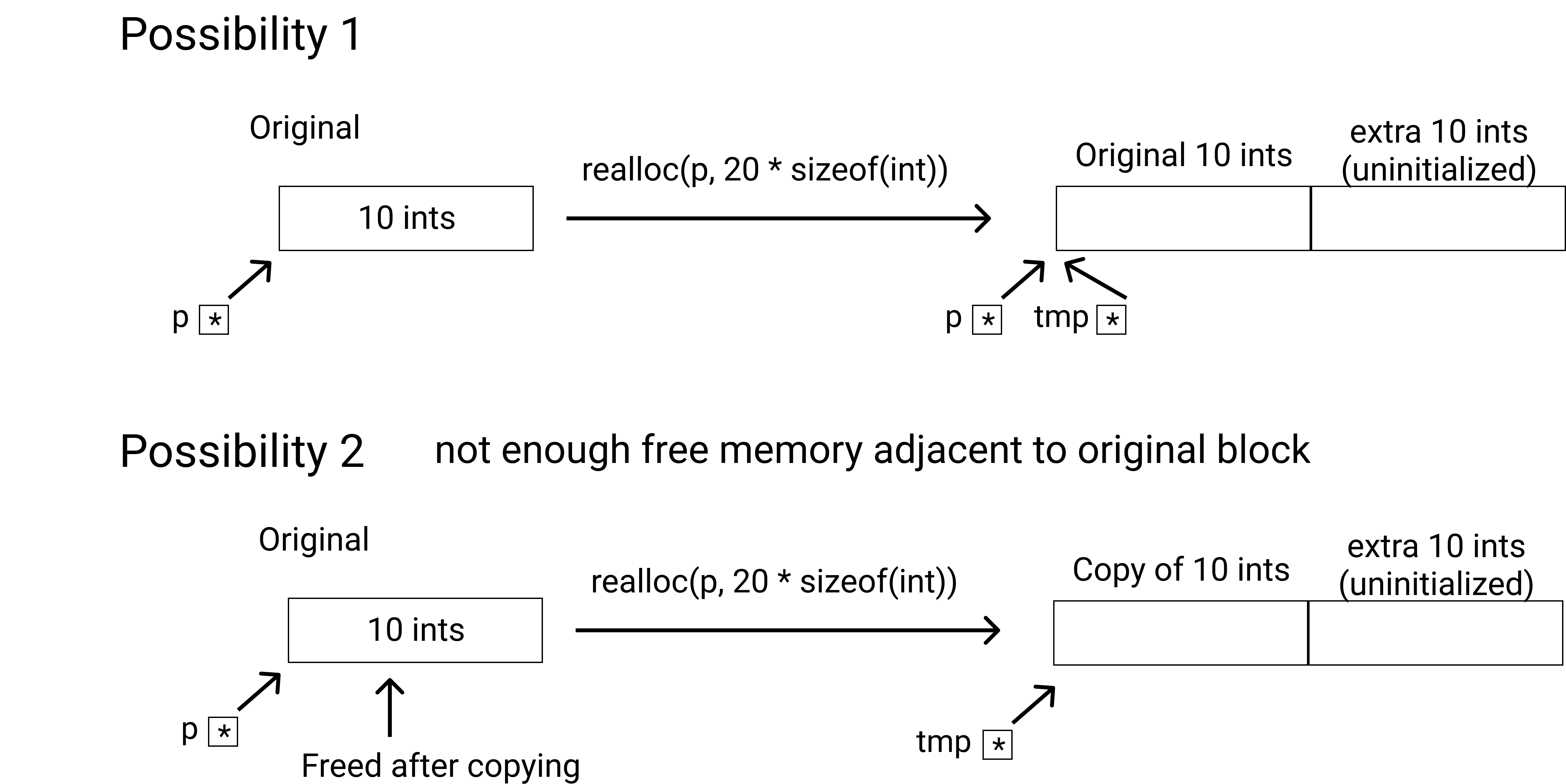
- Dynamic memory is allocated on the heap
figure… add it later
Examples: storing lines of texts
Version 1.
#define LINESIZE 100
#define NLINES 10000

char lines[NLINES][LINESIZE]; /* 20 array: lines is an array
																	of NLINES objects each an array
                                  of LINESIZE chars */
size_t i, j;
for (i = 0; i < NLINES; i++) {
  if(!fgets(lines[i], LINESIZE, stdin))
    break; /* if you can't read a line, break */
}

/* example: print back the lines */
for (j = 0; j < i; j++)
  printf("%s", lines[j]);
- Disadvantage: not flexible; may be wasting memory
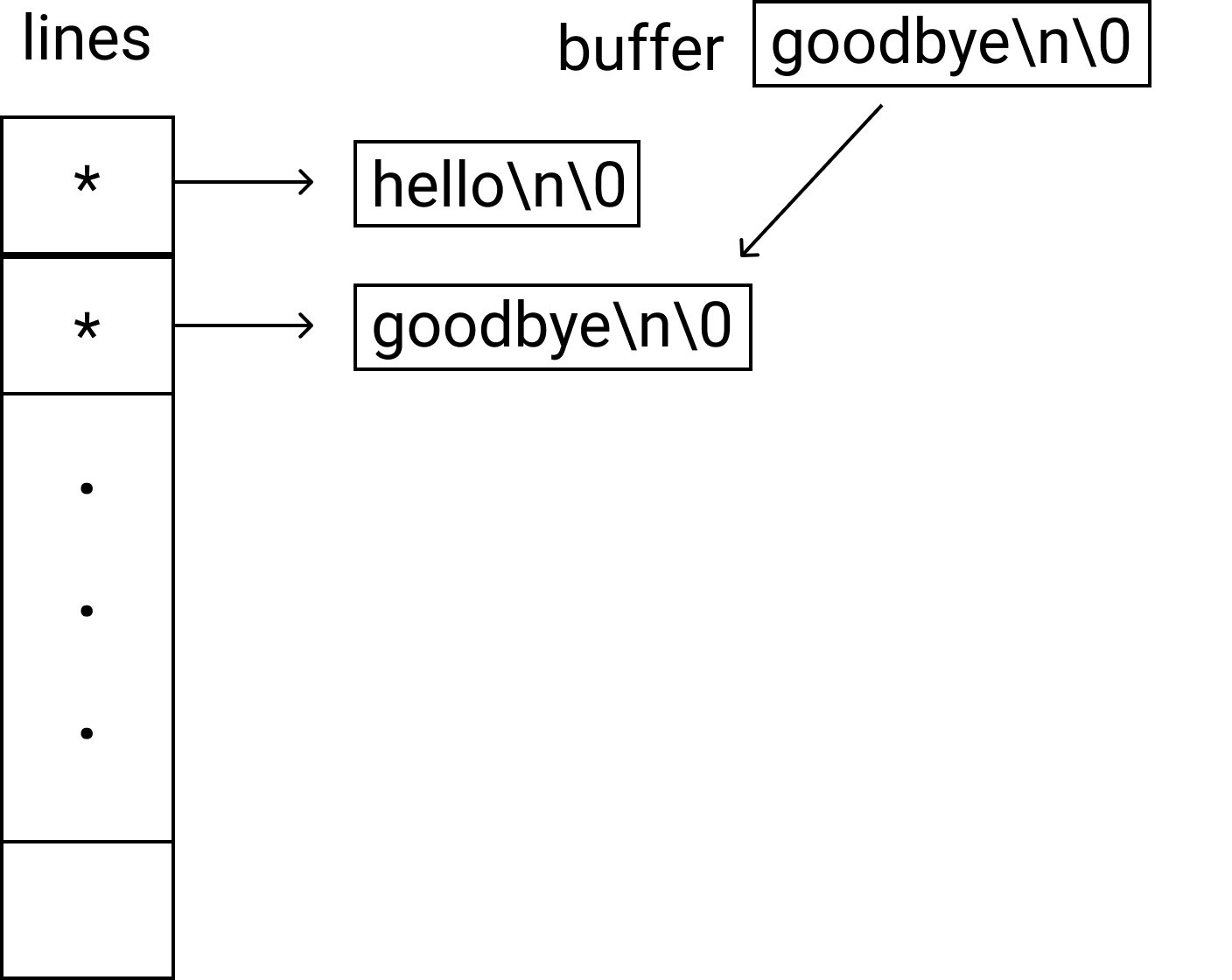
Version 2.
Maximum number of lines is still fixed
but each line is dynamically–allocated + just fits the input line
#define NLINES 10000
#define BUFSIZE 1024

char *lines[NLINES];
char buffer[BUFSIZE];
size_t i, j;

for(i = 0; i < NLINES; i++) {
  if(!fgets(buffer, BUFSIZE, stdin))
    break;
  lines[i] = malloc(strlen(buffer) + 1); /* +1 for nulll char */
  if(lines[i] == 0) {
    fprintf(stderr, "malloc failed\n");
    break;
  }
  strcpy(lines[i], buffer);
}

/* example: print back the lines */
for(j = 0; j < i; j++) {
  printf("%s", lines[j]);
}

/* deallocate memory when done */
for (j = 0; j < i; j++)
  free(lines[j]);
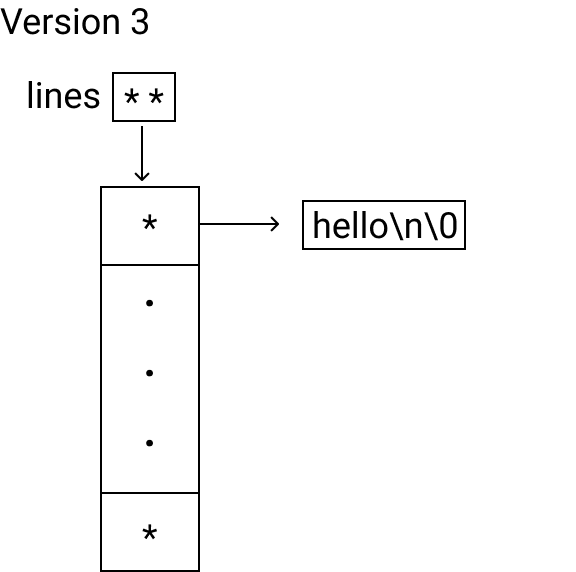
Version 3
- Remove the restriction to at most NLINES lines
#define BUFSIZE 1024
#define BLOCK 10
char **lines;
char buffer[BUFSIZE];
size_t nalloc, nused;

lines = 0; /* initializing lines as a null pointer */
nalloc = nused = 0;

/* as long as we can read a line */
while(fgets(buffer, BUFSIZE, stdin)) {

	/* if we have used up the allocated pointers */
  if(nused == nalloc) {

    /* add BLOCK more pointers */
    char ** tmp = realloc(lines, (nalloc + BLOCK) * sizeof(char*));
    if(temp == 0) {
      fprintf(stderr, "realloc failed\n");
      break;
    }
    lines = tmp;
    nalloc += BLOCK;
  }

  /* there are unused pointers */
  lines[nused] = malloc(strlen(buffer) + 1);
  if(lines[nused] == 0) {
    fprintf(stderr, "malloc failed\n");
    break;
  }
  strcpy(lines[nused++], buffer);
}

/* example: printing back the lines */
for (i = 0; i < nused; i++){
  printf("%s", lines[i]);
}

/* deallocate memory when done */
for (i = 0; i < nused; i++)
  free(lines[i]);
free(lines);