Pointer Arithmetic
example
#include <stdio.h>
int main(void) {
  /*
  char a[] = “hello”;
  char *p = a;
  */
  int a[] = {3, 2, 7, 6, 8};
  int *p = a;
  printf(“%p %p\n”, (void *)a, (void *) (a+1));
  /* +1 adds the number of size of the type  (int = 4, char = 1) */
  printf(“%p %p\n”, (void *)p, (void *) (p+1));
  return 0;
}
ex. char a[] = "hello";
a is the starting address of the array & is the address of the first character
a+1 is the addresss of the 2nd character; we can define a+2, a+3, ….
We can do the same thing for p where char *p = a;
There are other addresses & pointer operations: p, q pointers or addresses
ex. p < q, p <= q, p > q, p >= q, p == q, p !=qif ("hello" == "world") .... /* comparing addresses; usually not what we want */ /* use strcmp to compare strings */
“New” operations
p + 1, p + 2, ..., p++, ++p
p - 1, p - 2, ..., p--, --p
- p+1 or p+2 can be used for address or pointers
- p++, ++p, p–, –p can only be used for pointers
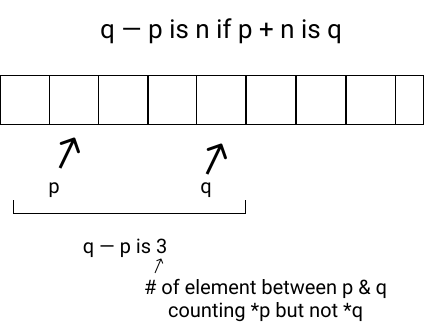
Subtraction of pointers / addresses
Standard idiom to process a string (pointer version)
- Assume s is the string we want to process
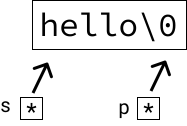
(const) char *p;
for (p = s; *p != '\0'; p++)
	/* process *p */
Example
1) length of string
size_t str_length(const char *s) {
  const char *p;
  for (p = s; p != '\0'; p++) {
    ;
  }
  return p - s;
}
2) looking for a char in a string
strchr- version in standard library
char* str_find(const char *s, int *) {
  const char *p;
  for(p = s; *p != '\0' (*p also works but not as readable); p++)
    if(*p == x)
      return (char *) p;
  return 0;
}
3) copying a string
/* version 1 */
void str_copy(char * dest, const char * src) {
  char * d;
	const char * s;
  for(s = src, d = dest; *s != '\0'; s++, d++){
    *d = *s;
  }
  *d = *s;
  /* or, *d = '\0'; */
}

/* version 2 */
void str_copy(char * dest, const char * src) {
  for(; *src != '\0'; src++, dest++){
    *dest = *src;
  }
  *dest = *src;
  /* or, *dest = '\0'; */
}

/* version 3 */
void str_copy(char * dest, const char * src) {
  for(; *src != '\0';){
    *dest++ = *src++;
  }
  *dest = *src;
  /* or, *dest = '\0'; */
}

/* version 4 */
void str_copy(char * dest, const char * src) {
	while((*dest++ = *src++) != '\0')
    ;
}

/* version 5.1 */
void str_copy(char * dest, const char * src) {
	while(*dest++ = *src++)
    ;
}

/* ususally it's a common mistake to put assignment (=) in the
condition statement of while()
ex. if(x=2)...
So compiler would warn you */

/* version 5.2 */
void str_copy(char * dest, const char * src) {
	while((*dest++ = *src++))
    /* this one more parenthesis suppress the warning */
    ;
}
What does *p++ do??
Actually, there are 4 versions:
*p++,++*p,*++p,(*p)++1) *p++ - the most difficult case, but most common. /* Is this (*p)++ or *(p++)?? */ /* By looking at the precedence table, we see that *p++ ≣ *(p++) */ 2) ++*p /* ++(*p) or (++*)p */ /* answer: ++(*p)*/ 3) *++p /* *(++p) or (*++)p */ /* answer: *(++p)*/*p++is the most useful;- process
*p - increment
pto point to the following element.
- process
Recalll that if a is the address of an element in an array, then a + 1 is the address of the following element.
Similarly, if p points to an element in an array, p + 1 points to the following element.
Example
1)
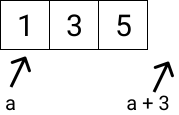
int a[] = {1, 3, 5};
int *p = a + 1;
printf("%d", *p++); // 3
printf("%d", *p); // 5

2)
int a[] = {1, 3, 5};
int *p = a + 1;
printf("%d", ++*p); // 4
printf("%d", *p); // 4

3)
int a[] = {1, 3, 5};
int *p = a + 1;
printf("%d", *++p); // 5
printf("%d", *p); // 5

4)
int a[] = {1, 3, 5};
int *p = a + 1;
printf("%d", (*p)++); // 3
printf("%d", *p); // 4
- Similarly, we have
*p--,--*p,*--p,(*p)--
Example. looking for a char in a string (recursive version)
char * str_find(const char *s, int x) {
  if(*s == '\0')
    reutrn 0;

  if(*s == x)
    return (char *)s;
  return str_find(s + 1, x);
  /* using ternary operator */
  /* or return (*s == x) ? (char *)s : str_find(s + 1, x); */
}
Standard idiom to process an array (pointer version)
T a[N]; /* T: some type, N: some positive integer */
(const) T *p;
for (p = a; p < a + N; p++)
  /* process *p */
int a[] = {1, 3, 5};
Example
1) Maximum of an integer array
int arr_max (const int *a, size_t n) {
  /* precondition : n > 0 */
  const int *p;
  int 			max = *a;
  for (p = a; p < a + n; p++)
    if (*p > max)
      max = *p;
  return max;
}
2) Looking for an integer in an integer array
int * arr_find (const int * a, size_t n, int *) {
  const int *p;
	for (p = a; p < a + n; p++)
    if(*p == x)
      return (int *)p;
  return 0;
}